
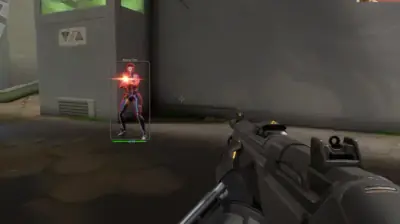
Valorant ESP: Reading Utility, Not Just Bodies
Boxes on enemies is the easy part. The Valorant ESP layer that actually changes rounds is the utility and spike tracking, and it needs different settings.
Every Valorant cheat page leads with enemy boxes because that is what people search for. It is also the least interesting layer in the game. Seeing an enemy is a problem your ears solve most of the time. Seeing a tripwire you were about to walk into is a problem your ears cannot solve at all.
The build has both. This is about the second one.
The player layer, briefly
Health bar, shield bar, agent, rank, level, equipment name, distance, box, snapline, view direction, skeleton, head circle, max distance.
Agent and equipment name are worth keeping. Knowing the enemy is a Jett with an Operator before you swing is a different decision than a Sage with a shotgun. Rank tells you how much respect the player behind the crosshair deserves in the first thirty seconds.
Boxes and head circles together is fine. Skeletons are better in a stack and worse in a long lane. Snaplines are useful for a week and then become noise.
The utility layer, which is the point
Ability and trap markers, per character, with full coverage of every agent's kit.
Concretely, what that buys you:
Sentinel setups. Cypher trips, cages and spycam. Killjoy turret, alarmbot and nanoswarm. Vyse arc rose, shear and razorvine. Sage wall. Deadlock sonic sensor and mesh. You see the setup before you commit, so you can break it with a flash, a dart, a Molly or a different entrance instead of finding it with your face.
Recon. Sova dart, Fade haunt and prowler, Skye bird. Knowing a recon is inbound tells you to break line before it lands, which is the difference between being scanned and being seen.
Smokes and walls. Omen, Brimstone, Astra and Harbor utility marked means you know which angle is blind and which is not.
Mobility. Jett dash, Raze satchel, Neon sprint. Less about the marker and more about knowing what is available to the player holding that angle.
Spike tracking
Defuse progress and remaining time, through walls.
This is the single most useful line in the overlay. Defuse progress tells you whether you can win by time or whether you have to take the fight. The timer tells you how many seconds of the round are actually left.
Half the clutches in this game are arithmetic, and the game only shows you the arithmetic when you can see the spike.
Combat mode
The utility layer is valuable before a fight and cluttering during one. There is a combat mode hotkey that hides ability and trap ESP the moment you engage, and puts it back when you disengage.
Set it. Bind it somewhere your hand already sits. Do not try to manage this manually mid spray.
Filtering the player layer
Enemy only. Always. Teammates produce half the boxes on screen and none of the threats.
Max distance at 60 to 80 metres in competitive. Valorant lanes are short. Beyond that you are tagging people through two walls who cannot see you.
Visible check on. Off, you rotate toward players who have not seen you, and you walk into the one angle they are holding.
Drop snaplines and skeletons once you know the map. Keep boxes, health, shield and equipment.
What the ESP will not do
It will not tell you where a player is looking if you never read the view direction arrow. That is a habit, not a setting.
It will not stop you losing a straight 1v1. If your crosshair placement is bad, information just means you die with more notice.
It will not tell you how many are on site beyond what you can see. Rotations still have to be read.
Stream proof
If you stream, stream proof keeps the overlay off capture and off screenshots. On before you go live.
A working config
Competitive: enemy only, box, health, shield, agent, equipment, distance, visible check, 70 metre cap, utility and spike on, combat mode bound.
Deathmatch: enemy only, box, health, distance, no cap, utility off, combat mode bound.
Save both. Load one.