
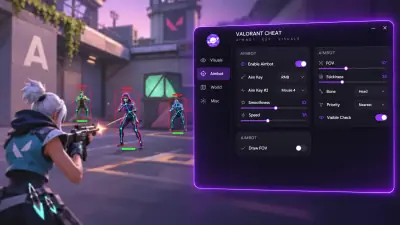
Valorant Aimbot Settings for a Game With a Short TTK
Valorant's TTK is short enough that a weak aimbot wins fights. Set FOV, smoothing, stickiness and bone in the right order and it stops looking mechanical.
Valorant kills fast. One Vandal headshot, one Operator body shot, one judge to the chest at five metres. There is no long tracking phase like Apex and no spray transfer across forty metres. A duel is often decided in a third of a second.
That changes how an aimbot should be set up. In a long TTK game you want smooth tracking that keeps the crosshair on a strafing target. In Valorant you want a small, fast correction that lands on the right pixel and then stops.
FOV is the dial that decides everything
FOV is the radius around your crosshair where the aimbot is allowed to pull. Everything else is downstream.
Valorant players hold tight angles. A 2 to 4 degree FOV is the honest range. At 4 it covers the correction a good player makes anyway. At 8 it starts grabbing targets your crosshair was nowhere near, and that is the clip people post.
Start at 3. If you are losing duels you should win, go to 4. Do not go past 5 unless you are playing something with spread and volume.
Speed and smoothness are not the same dial
Speed is how fast the aim travels once it engages. Smoothness is how much the travel is eased. Running both high produces a slow drift that loses to a swinging Jett. Running both low produces a snap.
For Valorant:
- Rifle duels at 15 to 30 metres: low smoothing, moderate speed
- Operator holds: very low smoothing, high speed, the shot is one frame
- Shotguns and SMGs inside 10 metres: low smoothing, high speed
- Pistol rounds: moderate both, you want to look like you are correcting
Stickiness, and why it is the underrated field
Stickiness keeps the aim attached once it engages. Low stickiness releases as soon as the target moves. High stickiness follows through a strafe, and follows through a smoke you did not want to shoot into.
Valorant values are lower than most games. Medium stickiness at most, low if you have any tendency to keep firing at a target that already broke line.
Bone selection
Head, for anything single fire. Vandal, Phantom first shot, Sheriff, Guardian, Operator.
Chest, for volume weapons. Judge, Odin, Ares, and any spray you take at range.
Do not leave it on head for a judge. The pellets do not care and you lose body coverage.
Visible check
On. Always.
Without it the aimbot pulls to players through walls and through smokes, and you end up prefiring angles nobody is holding. With it, the aim only engages when the hitbox is actually available.
This is also the field that most affects how human the aim looks, more than smoothness does.
Draw FOV and draw target line
Turn both on for the first week. The circle tells you what your settings are actually doing, and the target line tells you which player the aimbot has chosen.
Turn both off afterwards. They are training wheels and they clutter the screen.
The order to set it in
- FOV at 3
- Bone per weapon class
- Smoothness low
- Speed moderate
- Stickiness low to medium
- Visible check on
- Deathmatch for two games, adjust one value, repeat
One change at a time, or you learn nothing about any of them.
Aimbot filter
The filter decides who is eligible. Enemies only, and if the build allows it, exclude downed players so the aim does not grab a corpse while a live player swings.
What still looks wrong
Smoke sprays. You will shoot into smoke at people you cannot see if stickiness is high. Lower stickiness in smoke-heavy lobbies.
Perfect pre-aim. Rotating to a site already on the correct head height of the player holding it. Believable once, suspicious four times.
Snapping to a different target. Two enemies close together, the aim swaps mid spray. Raise stickiness slightly if this happens often.
Long range instant correction. A 40 metre Vandal correction that arrives in one frame. Slow the speed at range or accept it.
Competitive versus deathmatch
Deathmatch is the test bed. Run values you are unsure about there and let people see them, because deathmatch players are the ones who call it out.
Competitive is not a test bed. Freeze your config before you queue. Season V26 Act 6 runs to January, and a stable profile across a climb tells you more than a tweak every match.
Configs save and load. Keep a deathmatch profile and a competitive profile separate, and stop touching the competitive one mid session.